A Second Brain Meets Getting Things Done
A few months ago, I read Andrej Karpathy’s post on building a second brain with Claude and Obsidian. The concept was straightforward: capture your thoughts digitally, connect those thoughts together, and let a system hold what you’d otherwise carry in your head. I saw follow-up articles taking similar approaches, and they were solid work. But as I read them, I realized something was missing. None of them integrated with Getting Things Done (GTD), the methodology I’ve relied on for over fifteen years.
I’ve built successful GTD systems before. My OneNote setup served me well. But when I changed positions, I had to adopt Asana for project tracking. That’s when I noticed something useful: Claude and ChatGPT both connect to Asana. This gave me a vision. What if I could integrate all those things together, Getting Things Done and Second Brain, using Claude, Obsidian, and Asana? I could work in Claude, store them in Obsidian, and synchronize them with Asana.
The Hybrid System
I started with PARA: Projects, Areas, Resources, Archive. It’s the organizing principle many second brain advocates use, and it’s a good enough place to start. But I wasn’t willing to drop the inbox, which is core to Getting Things Done. So I built both. PARA gives me permanent organization, and the inbox catches everything that needs processing and clarification before it lands in the right place.
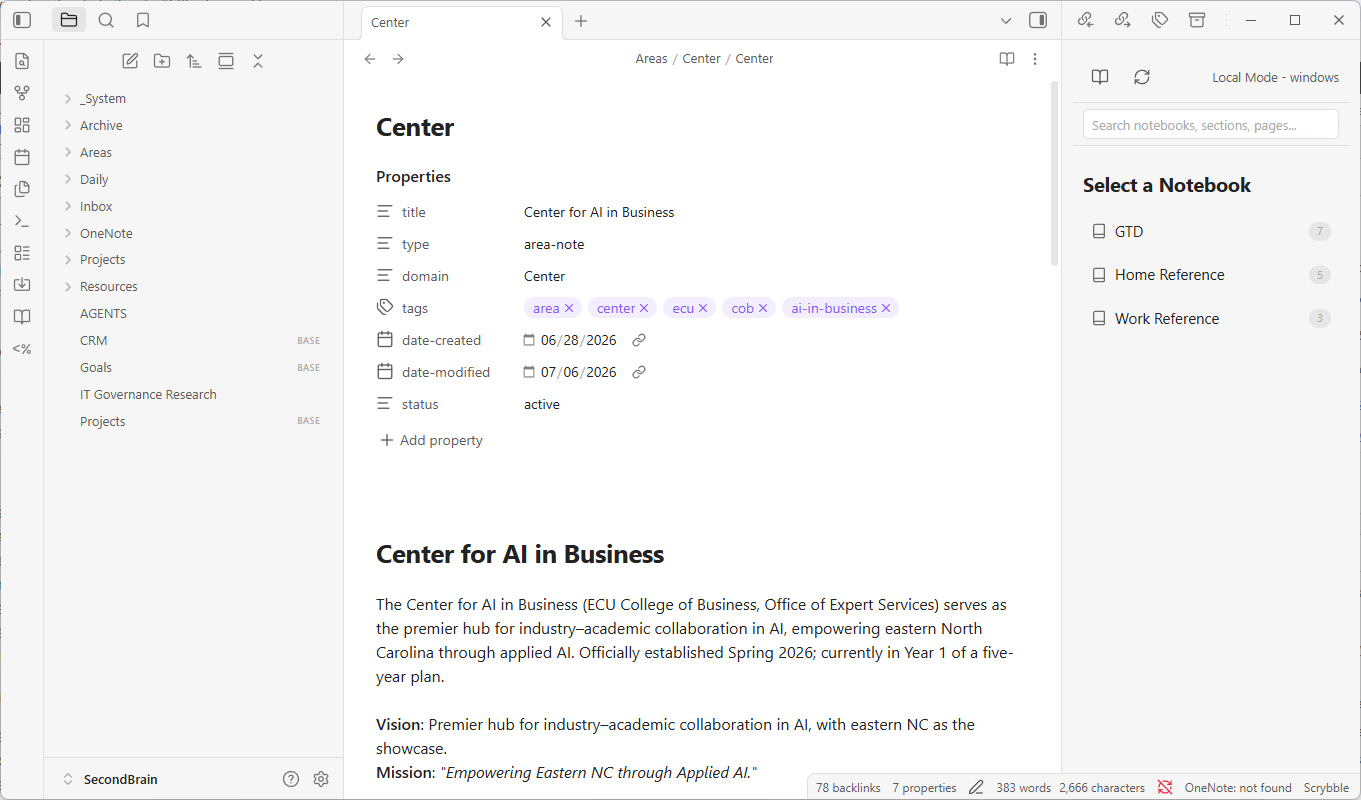
Beyond that, I added a few layers that sit outside strict PARA or GTD: a daily journal for tracking sleep, exercise, and daily reflections, and a system folder for notes about the system itself. Within Resources, I’ve built a people section that functions as a lightweight CRM, with contact information and context for colleagues across my projects and work in my center, teaching, and research. It’s convenient for staying connected without adding yet another tool.
The whole thing lives in Obsidian. Obsidian and Claude both work natively with something called markdown files, so there’s no friction between them. Claude actively modifies the folder structure through Cowork. But markdown files do something else that plain notes can’t: they link to each other. Every project can link to the people involved, every meeting note can link to the project it serves, and every idea can link to the resources that sparked it. In essence, the vault becomes a personal wiki, where the connections between notes carry as much value as the notes themselves.
Connecting Ideas to Work
Those links solve a problem both methodologies have when used alone. A second brain is where ideas live. Getting Things Done is where work happens. Keep them in separate tools and your ideas cannot inform your work and your work cannot relate to your ideas. At least, not without friction.
In this system, they’re the same set of files. A stray thought captured in the inbox can link to an active project. A resource I saved months ago resurfaces when Claude processes a related task. The idea side and the work side feed each other, which is exactly what neither Second Brain setup nor orthodox GTD gave me on its own.
Natural Language Connection
Of course, none of this structure would matter if maintaining it were a chore. Here is the biggest takeaway from the whole experiment: Claude lets me run this system in plain English.
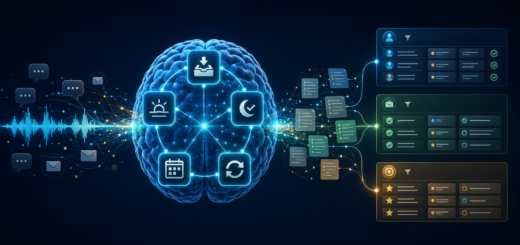
I don’t click through folders to file a note. I tell Claude what’s on my mind, and it clarifies what the item needs and routes it to the right place. I don’t manually review project lists. I ask what needs attention, and Claude reads across the vault and tells me. Capturing meeting notes from my reMarkable tablet, processing the inbox, updating projects: all of it happens through conversation.
That changes the economics of maintaining a system like this. Productivity systems and idea capture systems only work if there’s minimal upkeep. When the interface is natural language, the upkeep nearly disappears. The system works the way I tell it to work.
If you’ve tried and failed with GTD or a second brain before because the maintenance wore you down, this combination is worth a look. In the following blog posts, I’ll show some of the specifics of what I did.

2 Responses
[…] Done system running with Claude Cowork, but it didn’t quite fit my workflow. So I decided to integrate the two, and what emerged were five skills in Claude and three Bases in Obsidian. That number may change […]
[…] of the power behind AI is when automation makes work seamless. Part 1 in this series provided the architecture of my Second Brain while Part 2 provided the core work […]